Steel Fiber vs Rebar Cost: Which Is More Cost-Effective in 2026?
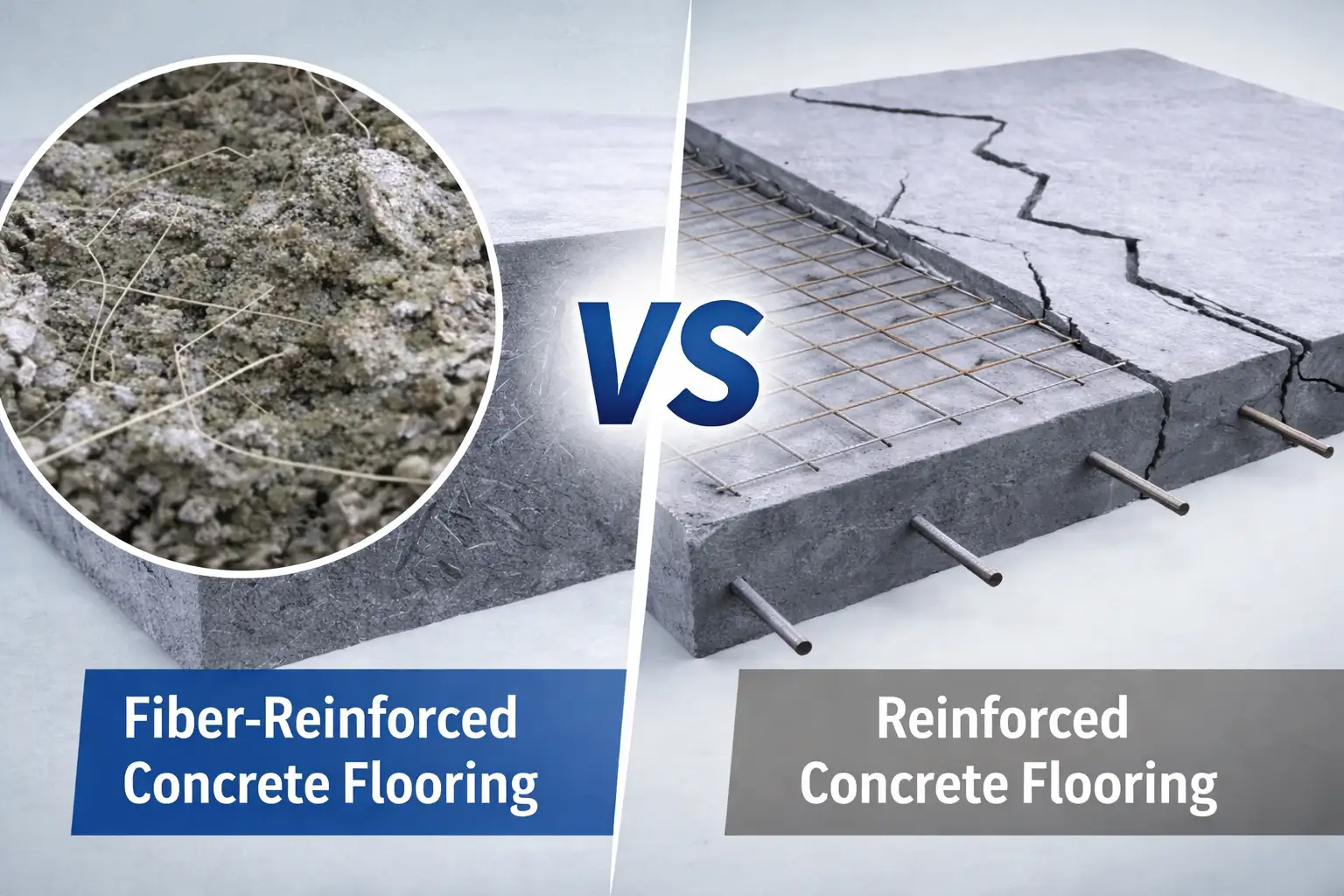
Steel fiber vs rebar cost is one of the most important considerations in concrete flooring projects.Compared to traditional rebar, steel fiber reinforcement can reduce overall project costs by 15%–30%.
Key Characteristics of Reinforced Concrete Floor Construction
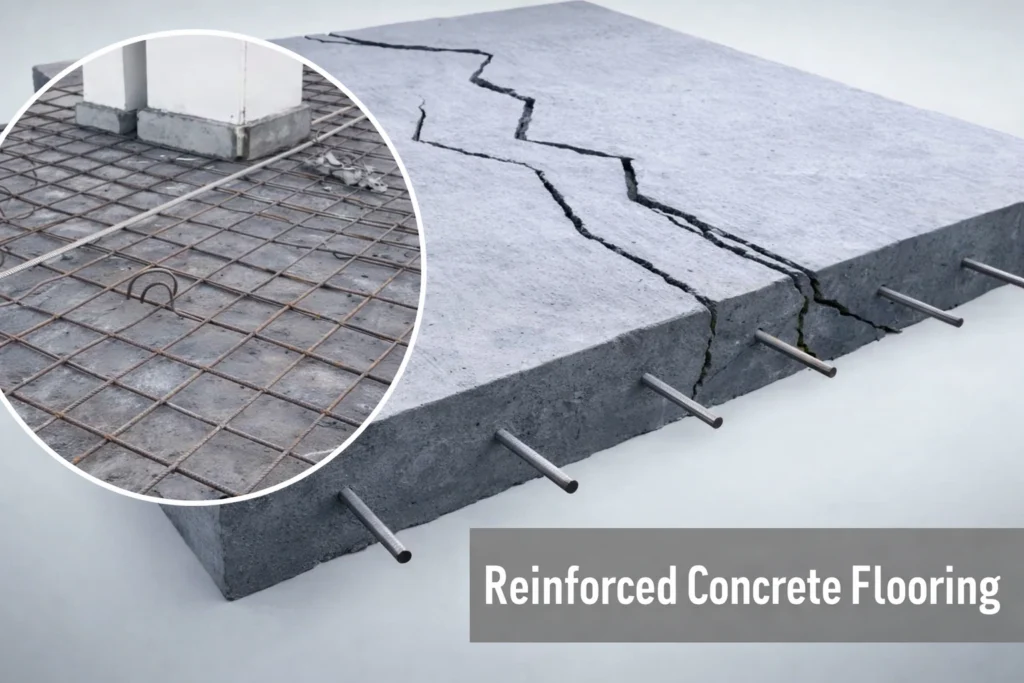
Reinforced concrete floors are widely used in industrial and commercial construction due to their strength and load-bearing capacity. However, their construction process involves several specific characteristics that impact cost, time, and performance.
- While rebar provides structural strength, it is less effective in controlling micro-cracks compared to distributed reinforcement methods.
- The quality of reinforcement largely depends on skilled workers to ensure correct spacing, positioning, and structural integrity.
- Slow construction speed, with each concrete pour typically limited to 800–1,000 m².
- Rebar positioning is difficult to maintain on-site due to machinery and foot traffic.
Due to these limitations, alternative reinforcement solutions such as steel fiber are increasingly used in modern concrete flooring to improve efficiency and reduce overall costs.
Why Construction Method Impacts Total Cost
Construction efficiency plays a critical role in determining the total cost of concrete flooring projects. Differences in installation methods directly affect labor, time, and overall budget.
Key Characteristics of Steel Fiber Reinforced Concrete Floor Construction
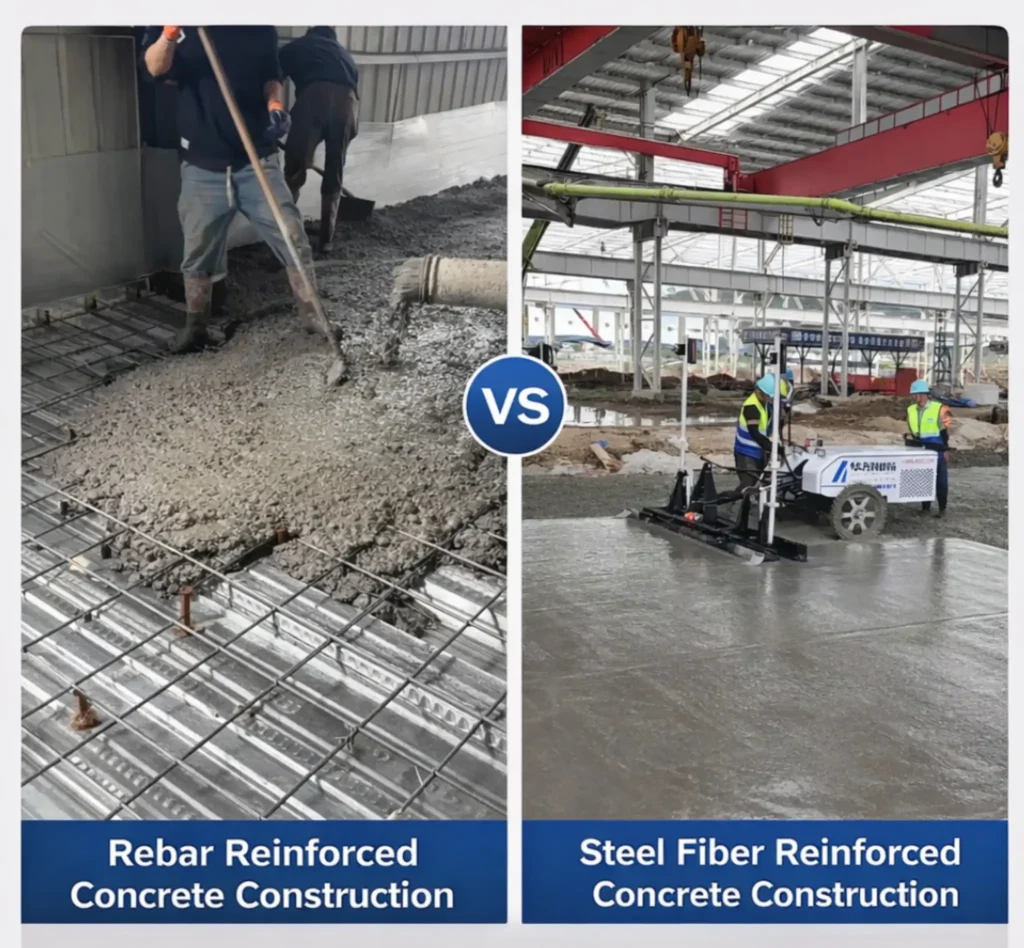
When comparing steel fiber vs rebar cost, steel fiber reinforced concrete floors offer a more efficient and streamlined construction process. The fibers are mixed directly into the concrete, eliminating the need for on-site installation and enabling faster pouring with more consistent performance. This approach not only improves crack control but also reduces labor and overall project costs.
- Steel fibers are added at the batching plant, making the process fast and simple.
- No need for concrete pumping.
- Fast construction speed, with each pour covering up to 2,000 m².
- Lower labor requirements, with construction time reduced by over 30%.
Steel Fiber vs Rebar Cost Comparison
🟢 Reinforced Concrete Floor (Rebar)
| Floor Thickness (mm) | Rebar Diameter (mm) | Spacing (mm) | Layers | Steel Consumption (kg/m²) | Rebar Price (USD/kg) | Binding Cost (USD/kg) |
|---|---|---|---|---|---|---|
| 200 | 12 | 150 | 2 | 17.26 | 0.71 | 0.14 |
🔵 Steel Fiber Reinforced Concrete Floor
| Floor Thickness (mm) | Fiber Type | Dosage (kg/m³) | Consumption (kg/m²) | Purchase Price (USD/kg) | Selling Price (USD/kg) | Cost per m² (USD/m²) |
|---|---|---|---|---|---|---|
| 200 | 80/60G | 20 | 4 | 1.71 | 1.71 | 6.86 |
In terms of steel fiber vs rebar cost, steel fiber consumption is only 4 kg/m² compared to 17.26 kg/m² for rebar. Despite the higher unit price, steel fiber delivers a similar or lower total cost per m², while significantly reducing labor and construction time.
Overall Cost Comparison
| Item | Rebar | Steel Fiber |
|---|---|---|
| Consumption (kg/m²) | 17.26 | 4 |
| Price (USD/kg) | 0.71 | 1.71 |
| Labor Cost | High | Low |
| Construction Speed | Slow | Fast |
| Total Cost | Higher | Lower |
Crack Control Comparison: Steel Fiber vs Traditional Rebar
Why Traditional Reinforced Concrete Floors Tend to Crack
In industrial flooring, long-term durability largely depends on how well cracking is controlled. While traditional rebar or mesh reinforcement has been widely used, its structural limitations make it less effective in modern high-performance applications.
In conventional concrete floors, reinforcement is placed in a two-dimensional (2D) layer within the slab. This type of reinforcement mainly works in specific directions and cannot provide uniform restraint throughout the entire concrete volume.
As a result, several issues may occur:
- The surface layer of concrete is more likely to experience peeling and spalling
- Internal cracks can develop and gradually extend to the surface
- Stress is not evenly distributed, leading to localized weaknesses
How Steel Fiber Reinforced Concrete Improves Crack Control
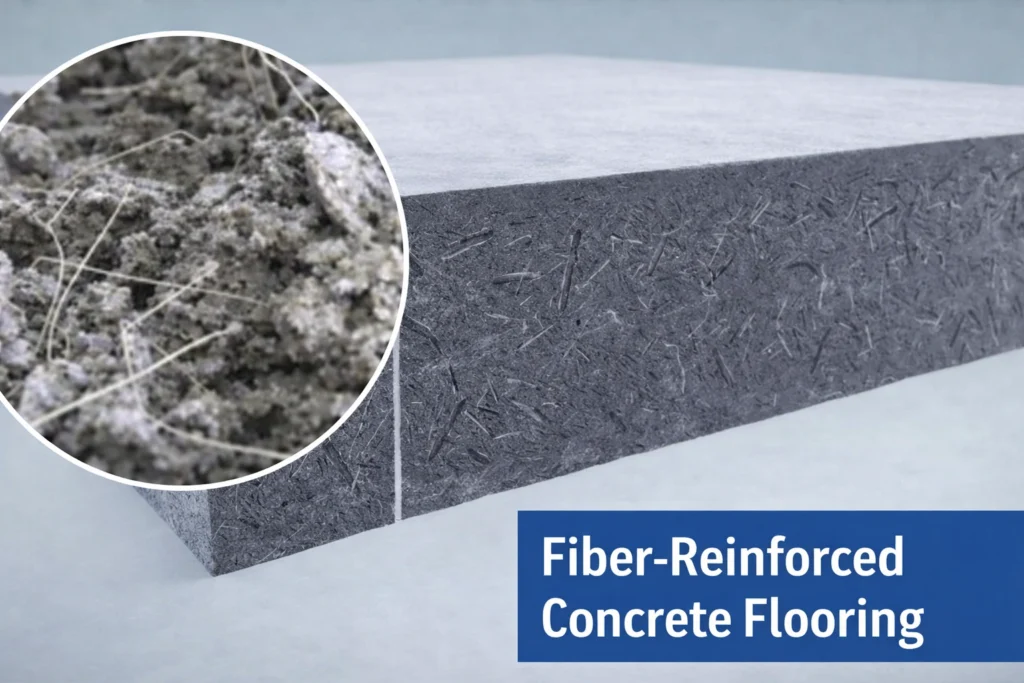
Steel fiber reinforced concrete (SFRC) uses a fundamentally different approach by integrating thousands of small steel fibers directly into the concrete mix.
Instead of relying on a single reinforcement layer, these fibers are randomly and evenly distributed throughout the entire concrete structure, forming a three-dimensional (3D) reinforcement network.
This results in:
- Multi-directional stress control within the concrete
- Enhanced tensile strength and crack resistance
- More uniform load distribution across the slab
As a result:
- Surface damage such as peeling is greatly reduced
- Cracks are controlled at an early stage before they spread
- Overall structural performance becomes more stable and reliable
You can read our detailed comparison of steel fiber vs rebar crack resistance here.
Why Choose Steel Fiber Concrete for Industrial Floors?
Compared to traditional rebar systems, steel fiber reinforced concrete (SFRC) provides superior crack control, longer service life, and reduced maintenance costs. It also performs more reliably under heavy loads, making it an ideal solution for industrial floors, warehouses, logistics centers, and other heavy-duty applications. Overall, SFRC offers a more durable and cost-efficient flooring solution.
According to ACI standards, proper crack control is essential for concrete durability.
Ready to improve your washing efficiency? Get your personalized solution today.

About the Author: Zhongdimei — Professional Construction and Flooring Materials Manufacturer Since 2015
We share company updates, industry insights, and technical knowledge grounded in real manufacturing experience and practical construction applications. Our content reflects Zhongdimei’s commitment to quality, innovation, and reliable material solutions for global construction and flooring projects.
Share
Product Category
Contact Us Today
Related Articles
-
2026-04-23
What is Steel Fiber Reinforcement for Concrete
Steel fiber reinforcement offers better crack control, extended service life, and lower maintenance costs than traditional rebar systems, especially in heavy-duty industrial concrete floor applications.ZMD offers high-quality steel fibers with a range of strength options, designed for reliable reinforcement in demanding concrete applications. Advantages of Using Steel Fiber Steel fiber significantly optimizes your project’s bottom…
-
2026-04-22
How to Install Armored Joints in Concrete Floors
What Is an Armored Joint in Concrete Flooring? An armored joint is a specialized expansion joint system used in concrete flooring to accommodate thermal expansion and contraction. It is typically made of steel or high-strength materials and installed at slab joints to protect edges from damage. Armored joints play a critical role in preventing cracking,…
-
2026-04-15
Steel Fiber Reinforced Concrete (SFRC): Engineering Guide
Steel Fiber Reinforced Concrete (SFRC) is a composite material consisting of hydraulic cements, fine and coarse aggregates, and discrete, randomly distributed steel fibers. It is designed to overcome the inherent brittleness of conventional concrete. The Role of Steel Fibers The primary function of steel fibers is to modify the mechanical properties of the concrete matrix,…
-

2026-04-14
How Steel Fiber Improves Ultra-High Performance Concrete (UHPC)
Steel fiber has a significant impact on the mechanical performance of ultra-high performance concrete (UHPC). It can effectively enhance key properties such as tensile strength, crack resistance, toughness, and ductility. This is mainly because steel fibers have much higher strength than the concrete matrix and form a strong bond with it, which helps prevent crack…