How Steel Fiber Improves Ultra-High Performance Concrete (UHPC)

Steel fiber has a significant impact on the mechanical performance of ultra-high performance concrete (UHPC). It can effectively enhance key properties such as tensile strength, crack resistance, toughness, and ductility.
This is mainly because steel fibers have much higher strength than the concrete matrix and form a strong bond with it, which helps prevent crack initiation and propagation. As the fiber content increases, the tensile strength of UHPC gradually improves, resulting in better overall structural performance.
Effect of Steel Fiber on the Flowability of Ultra-High Performance Concrete (UHPC)
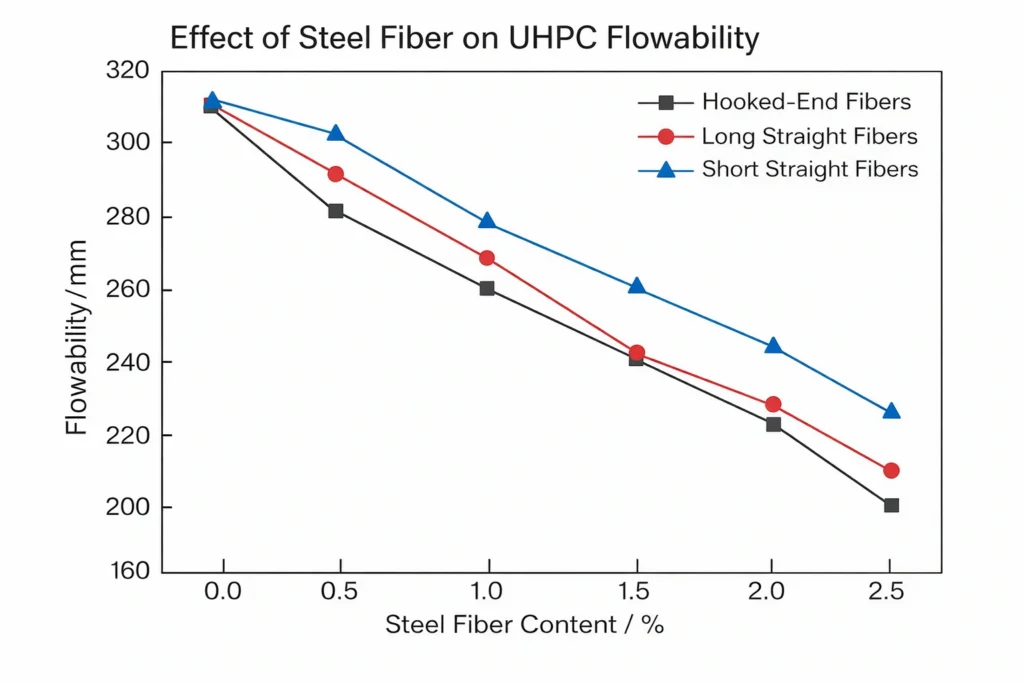
The addition of steel fibers has a negative impact on the flowability of ultra-high performance concrete (UHPC).
At the same fiber content, UHPC reinforced with short, straight fibers without hooks exhibits the best flowability, while both hooked-end fibers and longer straight fibers lead to varying degrees of reduction in flow performance.
This is mainly because longer fibers increase mixing resistance, and hooked-end fibers are more likely to interlock and form clumps during mixing, which further reduces workability.
When the steel fiber content exceeds 2.0%, the flowability of UHPC decreases significantly, resulting in poorer workability and more difficult construction.
Effect of Steel Fiber on the Compressive Strength of Ultra-High Performance Concrete (UHPC)
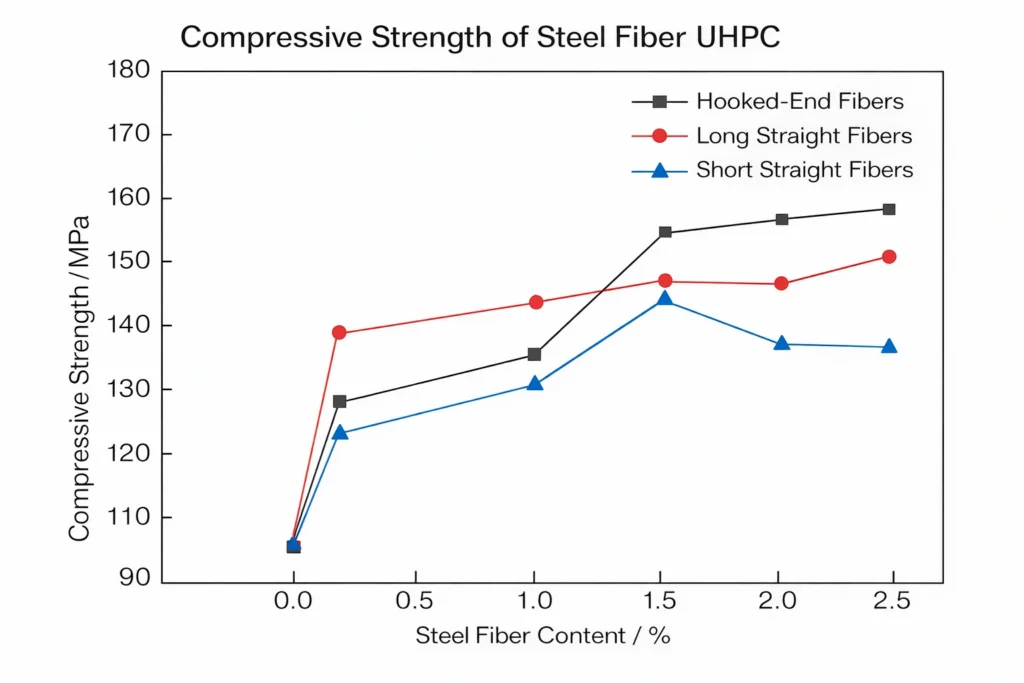
As the steel fiber content increases, the 28-day compressive strength of ultra-high performance concrete (UHPC) generally shows an upward trend. However, when the content of short, straight fibers without hooks exceeds 1.5%, the compressive strength begins to decrease.
When the steel fiber content is 0%, the 28-day compressive strength of the control group is 97.6 MPa. At a fiber content of 2.5%, the 28-day compressive strengths of UHPC reinforced with hooked-end fibers, long straight fibers without hooks, and short straight fibers without hooks reach 156.5 MPa, 147.4 MPa, and 130.6 MPa, respectively—representing increases of 60.3%, 51.0%, and 33.8% compared to the control group.
From the overall trend, hooked-end steel fibers provide the most significant strengthening effect. This is mainly due to their hooked geometry, which allows better mechanical anchorage and stronger bonding with the cement matrix, resulting in improved load transfer and confinement. Although the flowability of UHPC may decrease, the reinforcing effect on strength is more pronounced.
In contrast, short straight fibers without hooks can improve interfacial bonding and strength at lower dosages. However, when the content exceeds 1.5%, the fibers become difficult to disperse uniformly during mixing, leading to excessive clustering. In these areas, proper matrix encapsulation cannot be achieved, creating weak interfaces and ultimately reducing the compressive strength of UHPC.
Effect of Steel Fiber on the Flexural Strength of Ultra-High Performance Concrete (UHPC)
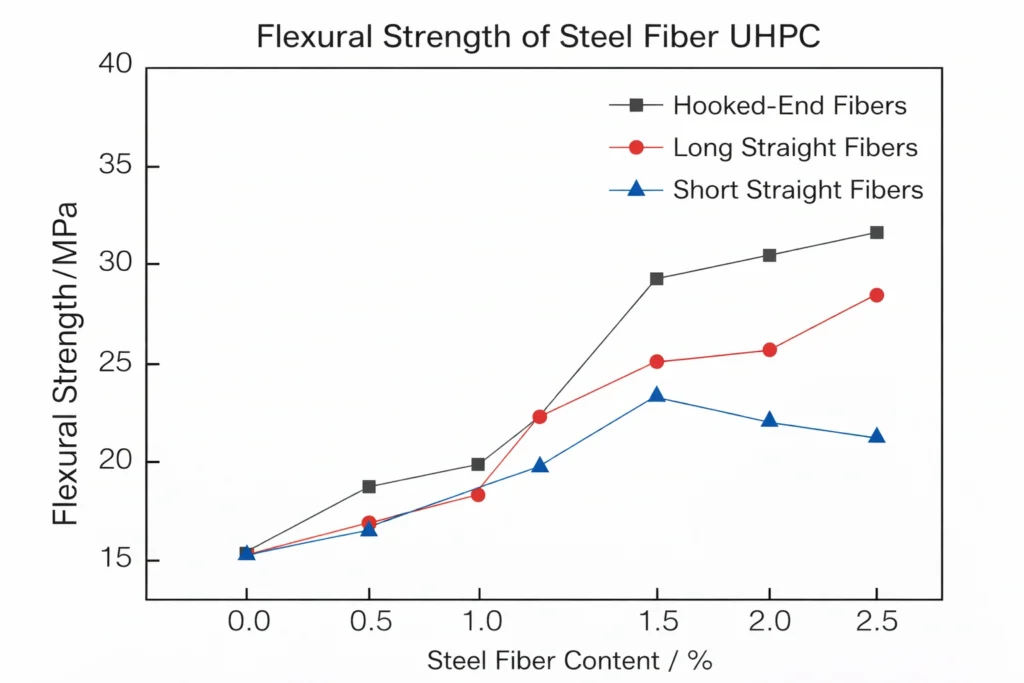
As the steel fiber content increases, the 28-day flexural strength of ultra-high performance concrete (UHPC) generally shows an upward trend. However, when the content of short, straight fibers without hooks exceeds 1.0%, the flexural strength begins to decrease.
When the steel fiber content is 0%, the 28-day flexural strength of the control group is 17.9 MPa. At a fiber content of 2.5%, the 28-day flexural strengths of UHPC reinforced with hooked-end fibers, long straight fibers without hooks, and short straight fibers without hooks reach 39.9 MPa, 32.5 MPa, and 22.7 MPa, respectively—representing increases of 122.9%, 81.6%, and 26.8% compared to the control group.
The improvement in flexural strength for hooked-end and long straight fibers is significantly greater than that in compressive strength. This is mainly due to the high toughness of steel fibers, as well as the effective bridging action provided by their length and, in the case of hooked-end fibers, mechanical anchorage at both ends. These factors enhance bonding with the matrix, improve crack resistance, and lead to superior flexural performance.
In contrast, short straight fibers without hooks have a shorter length, smooth surface, and no anchorage at the ends. Under flexural loading, weak points are more likely to develop at the interface between the fibers and the mortar. The fibers can be pulled out more easily, leading to premature cracking and lower flexural strength.
Effect of Steel Fiber on the Splitting Tensile Strength of Ultra-High Performance Concrete (UHPC)
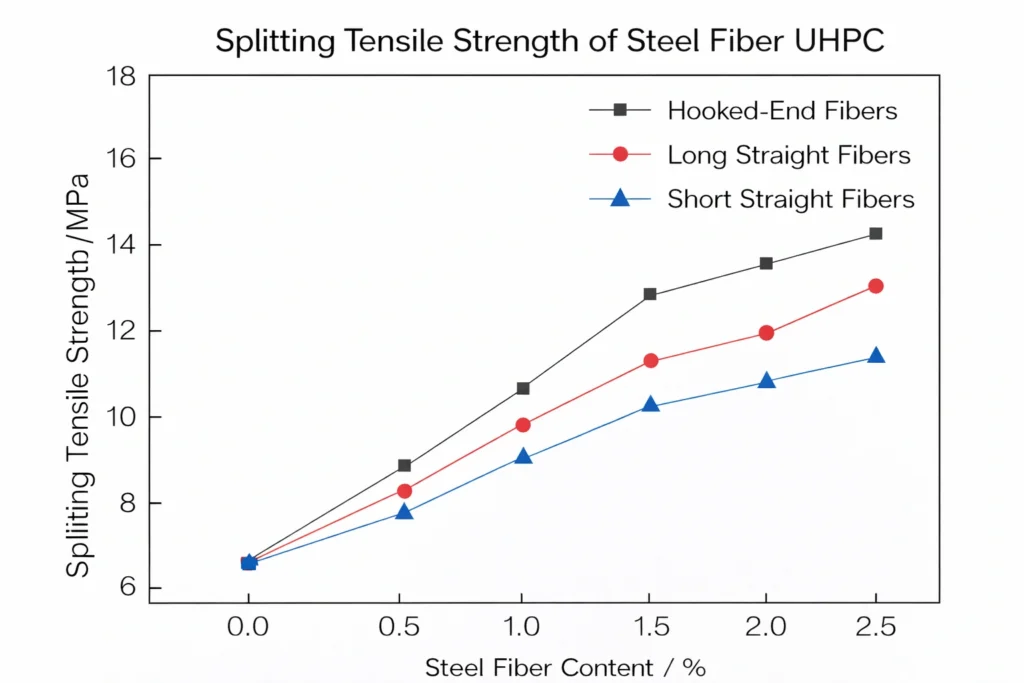
As the steel fiber content increases, the 28-day splitting tensile strength of ultra-high performance concrete (UHPC) improves significantly.
When the fiber content is 0%, the 28-day splitting tensile strength of the control group is 6.5 MPa. At a fiber content of 2.5%, the values for UHPC reinforced with hooked-end fibers, long straight fibers without hooks, and short straight fibers without hooks reach 16.5 MPa, 15.3 MPa, and 12.7 MPa, respectively—representing increases of 153.8%, 135.4%, and 95.4% compared to the control group.
Among the different fiber types, hooked-end steel fibers show the most significant improvement in splitting tensile strength. In contrast, when the content of short straight fibers without hooks exceeds 1.5%, the strengthening effect becomes less pronounced.
This indicates that fiber length and the presence of hooked ends play a key role in reinforcing the internal skeleton of UHPC and enhancing the bond at the fiber–matrix interface.
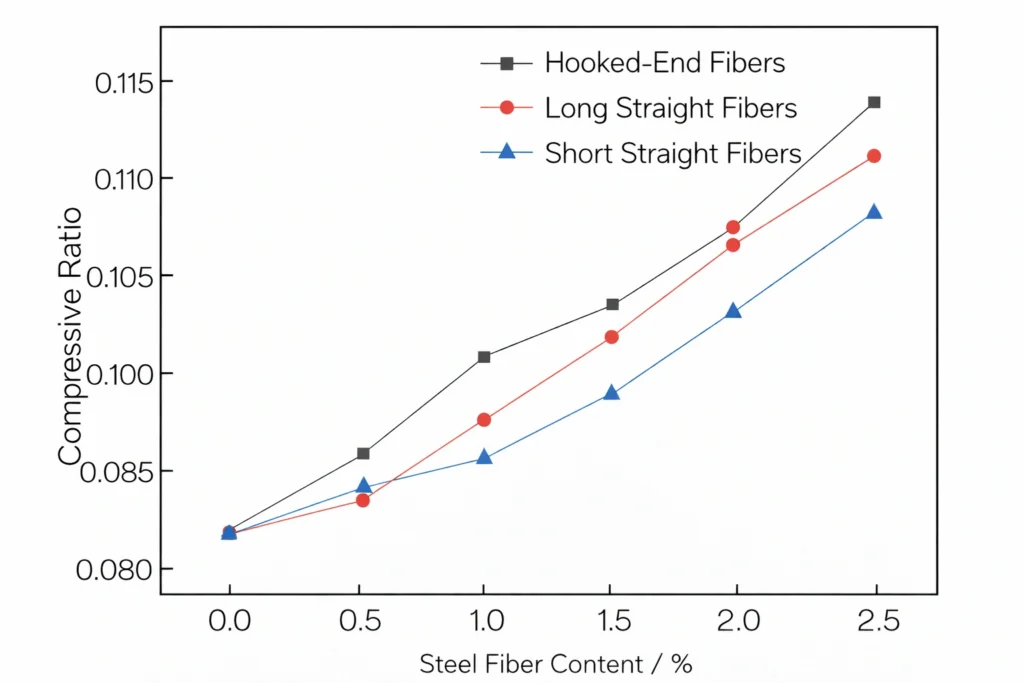
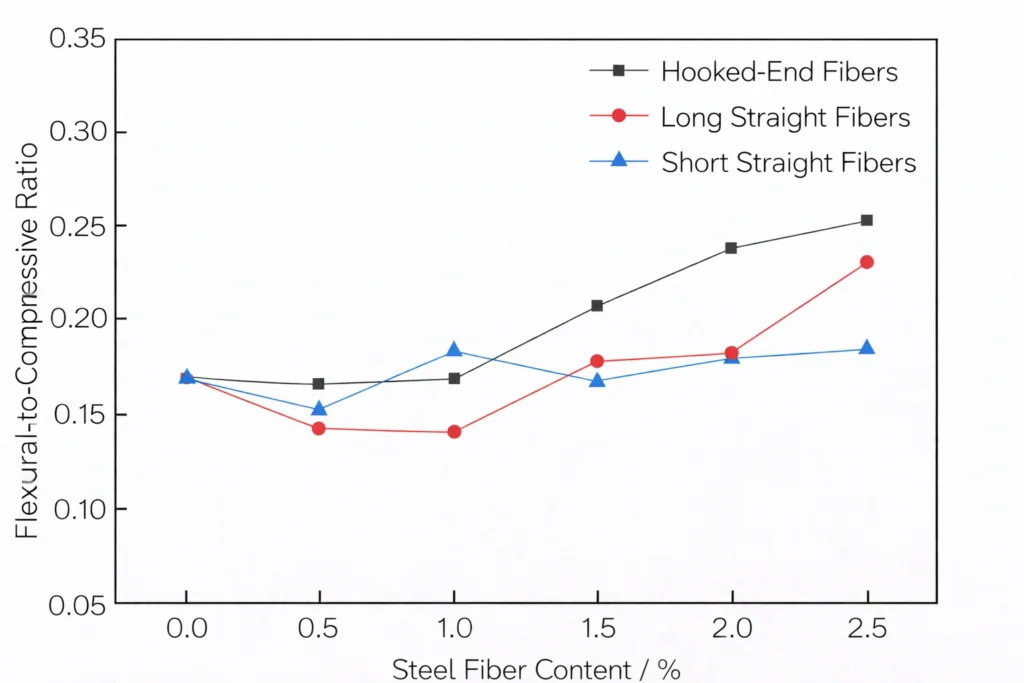
Effect of Steel Fiber on the Tensile-to-Compressive Ratio and Flexural-to-Compressive Ratio of Ultra-High Performance Concrete (UHPC)
The flexural-to-compressive strength ratio of concrete refers to the ratio of its flexural strength to compressive strength. It is commonly used to evaluate the toughness of concrete, especially in applications such as heavy-duty pavements and bridge engineering. A higher ratio indicates better toughness.
The tensile-to-compressive strength ratio refers to the ratio of splitting tensile strength to compressive strength. It is used to assess the safety and stability of concrete. A higher ratio indicates more stable performance and a lower risk of brittle failure.
As the steel fiber content increases, the tensile-to-compressive strength ratio of ultra-high performance concrete (UHPC) shows an overall increasing trend.
When the fiber content is 0%, the ratio for the control group is 0.08. At a fiber content of 2.5%, the tensile-to-compressive ratios of UHPC reinforced with hooked-end fibers, long straight fibers without hooks, and short straight fibers without hooks reach 0.115, 0.110, and 0.106, respectively—representing increases of 43.8%, 37.5%, and 32.5% compared to the control group.
When the steel fiber content is below 1.0%, the improvement in this ratio is relatively limited, indicating that low fiber dosages have little effect. However, when the content exceeds 1.0%, the enhancement becomes significant. This is because the fibers are better bonded with the mortar matrix, leading to improved stability and a lower risk of brittle failure.
The flexural-to-compressive strength ratio of UHPC reinforced with hooked-end and long straight fibers generally increases with fiber content, while that of short straight fibers first increases and then decreases.
When the fiber content is 0%, the control group has a ratio of 0.18. At 2.5% fiber content, the ratios for hooked-end, long straight, and short straight fibers reach 0.25, 0.23, and 0.18, respectively—representing increases of 38.9%, 27.8%, and 0%.
This indicates that increasing the content of short straight fibers without hooks does not improve toughness and may even reduce it. This is mainly because these fibers are shorter and lack anchorage at the ends. Under high stress during flexural loading, debonding between the fibers and the mortar is more likely to occur, resulting in weaker confinement and reduced toughness.
Conclusion
- The incorporation of steel fibers reduces the flowability of ultra-high performance concrete (UHPC), with hooked-end fibers having the most significant impact. When the fiber content exceeds 1.5%, the flowability decreases sharply. In particular, when hooked-end fibers exceed 2.0%, UHPC shows almost no flowability. Considering workability requirements, the optimal steel fiber content is recommended to be between 1.5% and 2.0%.
- The addition of steel fibers significantly enhances the mechanical properties of UHPC, with hooked-end fibers providing the greatest improvement. At a fiber content of 2.5%, the 28-day compressive strength, flexural strength, and splitting tensile strength reach 156.5 MPa, 39.9 MPa, and 16.5 MPa, respectively—showing substantial increases compared to the control group.
- As the steel fiber content increases, the tensile-to-compressive ratio of UHPC shows an overall upward trend. The flexural-to-compressive ratio also increases for hooked-end and long straight fibers, while it first increases and then decreases for short straight fibers. At the optimal fiber content, UHPC exhibits improved stability and toughness.
In addition, by using ZHONGDIMEI steel fiber products, UHPC performance can be further enhanced in terms of strength, crack resistance, and long-term durability.

About the Author: Zhongdimei — Professional Construction and Flooring Materials Manufacturer Since 2015
We share company updates, industry insights, and technical knowledge grounded in real manufacturing experience and practical construction applications. Our content reflects Zhongdimei’s commitment to quality, innovation, and reliable material solutions for global construction and flooring projects.
Share
Product Category
Contact Us Today
Related Articles
-
2026-04-23
What is Steel Fiber Reinforcement for Concrete
Steel fiber reinforcement offers better crack control, extended service life, and lower maintenance costs than traditional rebar systems, especially in heavy-duty industrial concrete floor applications.ZMD offers high-quality steel fibers with a range of strength options, designed for reliable reinforcement in demanding concrete applications. Advantages of Using Steel Fiber Steel fiber significantly optimizes your project’s bottom…
-
2026-04-22
How to Install Armored Joints in Concrete Floors
What Is an Armored Joint in Concrete Flooring? An armored joint is a specialized expansion joint system used in concrete flooring to accommodate thermal expansion and contraction. It is typically made of steel or high-strength materials and installed at slab joints to protect edges from damage. Armored joints play a critical role in preventing cracking,…
-
2026-04-17
Steel Fiber vs Rebar Cost: Which Is More Cost-Effective in 2026?
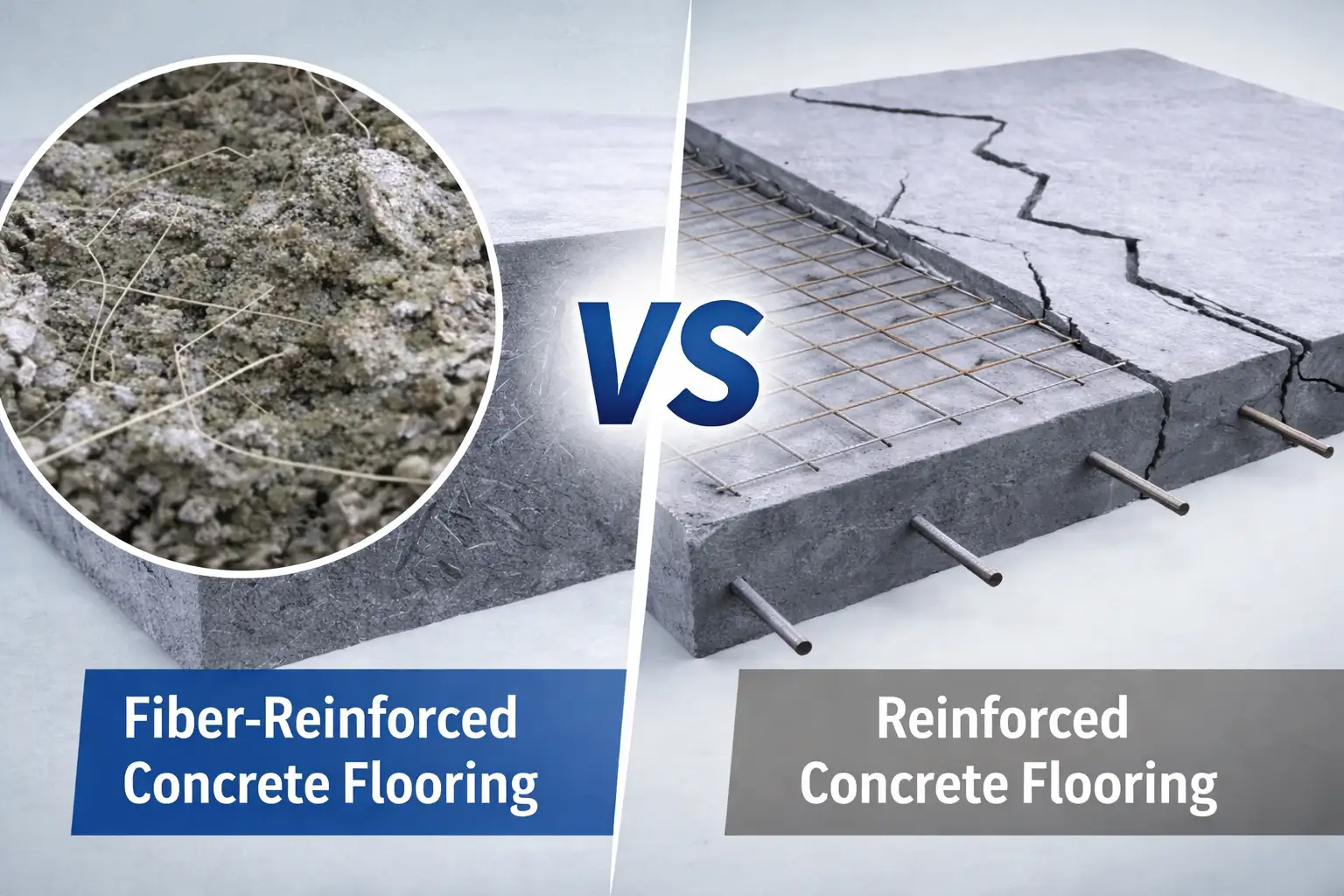
Steel fiber vs rebar cost is one of the most important considerations in concrete flooring projects.Compared to traditional rebar, steel fiber reinforcement can reduce overall project costs by 15%–30%. Key Characteristics of Reinforced Concrete Floor Construction Reinforced concrete floors are widely used in industrial and commercial construction due to their strength and load-bearing capacity. However,…
-
2026-04-15
Steel Fiber Reinforced Concrete (SFRC): Engineering Guide
Steel Fiber Reinforced Concrete (SFRC) is a composite material consisting of hydraulic cements, fine and coarse aggregates, and discrete, randomly distributed steel fibers. It is designed to overcome the inherent brittleness of conventional concrete. The Role of Steel Fibers The primary function of steel fibers is to modify the mechanical properties of the concrete matrix,…